The Body Electric
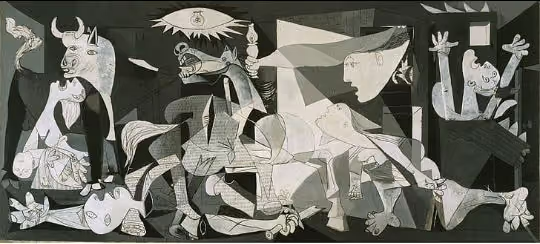
Pablo Picasso’s Guernica, public domain
I have a hard time comprehending the news *; it happens on a scale that is as uncontainable as the distances between stars or the billions of microorganisms contained in the gut. These are quantities that are not possible to comprehend in an embodied way; we can look at the numbers and we can do the math, but much of our understanding is via embodied intelligence, which is an intelligence that works largely at its own scale. A body best understands another body of its own scale. Physically, we can comprehend a home that our body inhabits, a hunger our body feels, a pain our body can imagine. This is the source of empathy, a recognition of like things in oneself and others. This is also why some argue that empathy is a bad tool for design, because it is innumerate and biased. They want to discard it completely in favor of rational calculation. I would argue we need to understand empathy better and learn to apply its brilliance more effectively.
Experience designers love to work toward awe and wonder. But what is awe and wonder? When the body tries to take in something it cannot comprehend, awe and wonder may follow. Most of the time, of course, we just turn away. I am thinking, here, about violence, and the incomprehensible scale of violence in the news. The wars in Gaza and Ukraine and Sudan. What can we say about this? What does it have to do with design, especially experience design?
Organizations, companies, religions, families, institutions, even buildings have their own origin stories. These are mythical, contentious, foundational narratives that tell us not so much histories as the nature of our world. We refer the present to them to see if we are on the right path. To generalize, small scale societies often reference world-creation narratives, while nation states frequently reference violent struggles for independence. I believe the answer lies in the stories we tell each other about our worlds – the origin stories.
I live in the United States. It’s a contentious time here to talk about origin stories.
But what if we had the chance to select a new origin story? Anything is possible in the imagination. Sometimes those imaginations become real.
Perhaps we can engage in a brief thought experiment…
A Thought Experiment

In many ways, the US Civil war is a more reasonable origin point for the United States than the war for independence*. It represented the full union of the states and the violent reckoning with the original sin of a nation built on the backs of African slaves**. An origin story needs a moral core, and I would argue that struggling against slavery and the abuse of human bodies is a more compelling core narrative than fighting taxation without representation.
The foundational text of the United States, if we source its origin at the war for independence, is the Declaration of Independence: a statement of moral values.
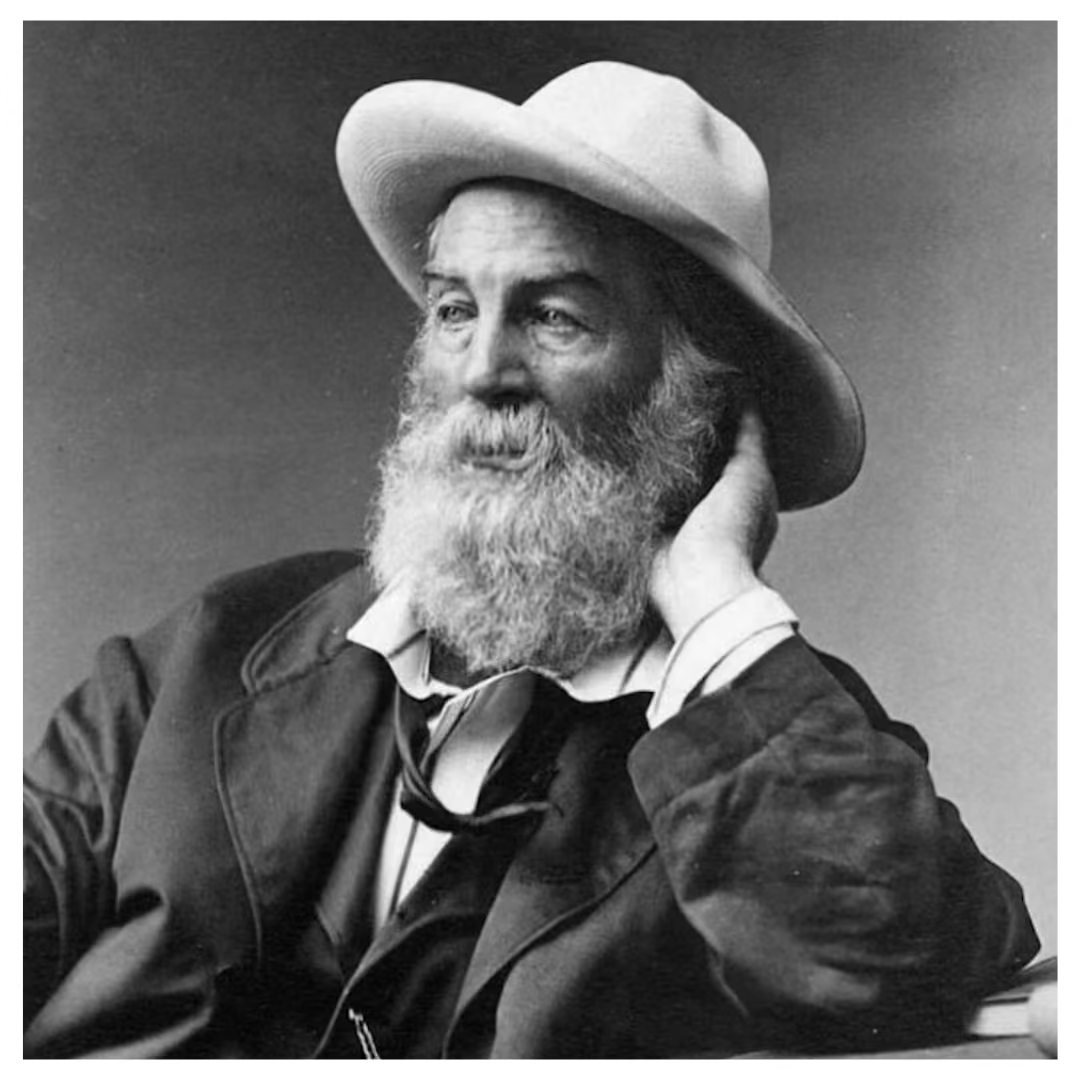
But what if we could wave a magic wand and choose a different foundational text from the Civil War. It might be tempting to choose The Emancipation Proclamation. But what if we chose something of broader reach, something that addressed not just an evil economic system, but our entire mode of relating to one another. I offer for this thought experiment Walt Whitman’s I Sing The Body Electric:
I sing the body electric,
The armies of those I love engirth me and I engirth them,
They will not let me off till I go with them, respond to them,
And discorrupt them, and charge them full with the charge of the soul.
Was it doubted that those who corrupt their own bodies conceal themselves?
And if those who defile the living are as bad as they who defile the dead?
And if the body does not do fully as much as the soul?
And if the body were not the soul, what is the soul?
Imagine, if you will, that this is the foundational text of your world. Imagine that every child studied it in school and when political arguments broke out they broke out over whether or not we were defiling the living, disrespecting bodies, turning away from engirthing those we love.
Whitman was witness to the Civil War, a nurse and a self-published poet. He was a lover of democracy, an anti-slavery writer, a queer man. He was complicated***, but the poem itself is clear in its implications: the ultimate good is the respect for the bodies of others. The ultimate pleasure is to be in company with others:
I have perceiv’d that to be with those I like is enough,
To stop in company with the rest at evening is enough,
To be surrounded by beautiful, curious, breathing, laughing flesh is enough,
To pass among them or touch any one, or rest my arm ever so lightly round his or her neck for a moment, what is this then?
I do not ask any more delight, I swim in it as in a sea.

What would it do to our current political argument if this were the foundational text we were debating? If instead of pledging allegiance to a flag, we recited this text? It’s hard for a world to remain whole when the foundational myth rings false to much of its population. If we relaunched the origin story at The Body Electric, post slavery and with a clear moral imperative****, could we perhaps find common ground again?
Our worlds are enormous collective design projects, as constructed as Tatooine or Westworld or the Lumon offices. Our worlds seem to be natural, to have emerged autonomously with their own logic, without the hands of designers. But this is not the case. We design America (or your country or your church or your family) just as much as we design a piece of immersive theater. It’s worth considering how we might redesign these once in a while.
On the Bookshelf: Ayden LeRoux’s Food Art Sex Books

Ayden LeRoux is in many ways the modern poet of the body. Her prose meditations on food, sex, bodies, and art are gorgeous, expansive, intelligent. I’ve worked closely with Ayden for more than a decade, and her new newsletter is a result of the well-deserved sabbatical she is taking from helming Odyssey Works with me. Of course, I’m biased. But I hope I have never pretended otherwise in these letters. I read a lot (though not half as much as Ayden) and I’ve encountered many writers talking about the subjects Ayden addresses. But no one does it with the same sense of what I can only call the obvious. This is something I look for in great writing – the sense that what the person is writing is not so much worked and reworked as obvious to who they are and where they find themselves. Ayden’s writing is this way. I recommend you start with the new newsletter, then dive into her other writings, then hold your breath for the fruits of her sabbatical year.
Notes
**Note that the other original sin of this country—its genocide of the Native population—was not addressed by the struggle between the states.
***Whitman, by today’s standards, certainly wasn’t a perfect antiracist. But we cannot judge historical figures by today’s standards. That’s the point of worldbuilding—we are products of the worlds we live in—and to step as far out from that world’s moral structure as Whitman does in his work is a remarkable act of will. Consider your own points of view: how many of them align perfectly with those of your community? With those of political leaders? How many of those points of view would have seemed alien to whatever communities you’d have been part of had you been born fifty years earlier, or one hundred? This is to say nothing of the 175 or so years since Whitman wrote Leaves of Grass. The point is not just to have compassion for people in the past, but to consider that worldbuilding may be more important than changing people’s opinions. The worlds we are in determine, for the most part, what opinions may even exist. To think outside of those boxes, as Whitman or Gandhi or other remarkable historical figures did, is truly transcendent.
****Not that the end of slavery put an end to the sins of the United States, but that’s not the point. It was a moment of moving in the right direction, and origin stories need such a movement, one to inspire a continuing movement in that direction. The world didn’t suddenly become compassionate upon reading Whitman, but if we could place the poem at the origin of America’s new moral trajectory, it would offer a clear direction toward something greater than bombs bursting in air.
