How We Fix It #1: A Phase Zero Approach to Architecture

Spring is here, and things are warming up but outside it’s still looking a bit…apocalyptic. You probably have your own list, but I’ve recently bumped AI gaining agency and deciding we’re not worth keeping around up near the top. Somewhere after that is climate, the rise of authoritarianism, social media addiction, tariff-induced-economic-collapse, and people using apostrophes to pluralize.
The thing about these apocalypses is that we have solutions for all of them. The technologies exist and the roadmaps are laid out. But we’re not employing them. They don’t have a place in our world.
So maybe we just need to change the world.
Sounds grandiose. But if you consider the notion that the world is built and rebuilt every day by every one of us, that it is an ongoing collective project, then the question should be: how might we do it differently?
Fortunately, we have tools for that.
The tools of experience design in general, and those of worldbuilding in particular, can be applied to to more than a Meow Wolf installation or a meditation retreat. They can address the problems of our larger world. I think about it all the time, and we’ve been experimenting with new approaches to design that might help us understand a solution. This newsletter is the first of a Phase Zero series I’m calling How We Fix It, which will look at some of these wicked problems and suggest an end run around them. I will look at them through a few lenses, focusing on different making practices— professional, artistic, personal—and hopefully open up a conversation with you.
The series begins with the premise that if we do things the way we’ve been doing them, in the thingy approach that keeps things-as-they-are then we never stop to consider the phase zero, and the phase zero is baked into things-as-they-are. Why don’t we reopen the question of how we wish our world to be?
A primary argument of this series is that while many of us feel we are not in places of power enough to address the wicked problems of the world, we are, in fact, conspiring to build the world every day. We can choose to do so differently.
In this series, I will cover working with AI, higher education, childhood and family structures, graphic design, immersive theater, and more. I’ll start where I started as a designer: with architecture…
They said, “You have a blue guitar,
You do not play things as they are.”
The man replied, “Things as they are
Are changed upon the blue guitar.”
-Wallace Stevens, The Man with the Blue Guitar (excerpt)
A Phase Zero Approach to Architecture
Architecture is probably the design practice most closely associated with worldbuilding. It quite literally builds the world. It has been a favorite starting place of utopianists and activists, as well as autocrats and historical revisionists. Our architecture (and urban planning) simultaneously structures our movement and social interaction and recites to us our communal narratives. Every architecture project is an enormous outlay of not just material and financial resources but social, spatial, and narrative resources as well.
A monastery. A university campus. A public square. A home. Each of these is a world, each deriving its identity from its built environment. There’s a long history of architects and urbanists striving to redesign a better world. LeCorbusier, Jane Jacobs, Paolo Soleri, Raj Rewal… too many to name here.
But architecture, by nature, tends toward thingy thinking. We are making a building. It will have this much floor space and these many rooms. It will be located here and have this energy profile. It’s hard not to get caught in the materiality of architecture. And, indeed, we need to spend a lot of time here, but, despite all the shiny magazines and cabin porn IG accounts, it is the life the structure potentiates that matters more than the thing itself. Or, as Laozi says in the Tao de Ching: “It is the empty space which makes the room useful.”*
This is the basis of my experimental practice The Long Architecture Project. I start with Phase Zero and work with clients to figure out what the impact they wish to have on the world is, what life they wish to live, how their values can become manifest during this enormous outlay of resources. Only then do we start looking at form.
Consider the brilliant work of Alejandro Aravena. His projects with families in South American slums engaged them in dialogue around how they wished to live and what mattered in a home and a community. This led him to an entirely unorthodox approach. Instead of building public housing and moving people into it, his studio built just “the hard parts” of the buildings and left the rest to the families to expand upon, to customize, to own. This meant people didn’t have to leave their communities or move into prescribed boxes. It meant they could develop their lives as they wished.
Aravena was asking: what is the experience we wish to create? rather than what should this house look like? He was doing so in part to maximize the impact of limited resources. Imagine if every building you entered were designed with phase zero at the front end. Rather than just checking sustainability boxes, might a building alter our understanding of our environment? Rather than just having a nice entry space, might a house actually generate community? Rather than just looking good in pictures, might a university building actually facilitate dialogue?
We expend so many resources on every building project, surely spending a little time up front considering a phase zero would be worth the investment. What if all architectural processes began this way? How quickly might we redesign our world?
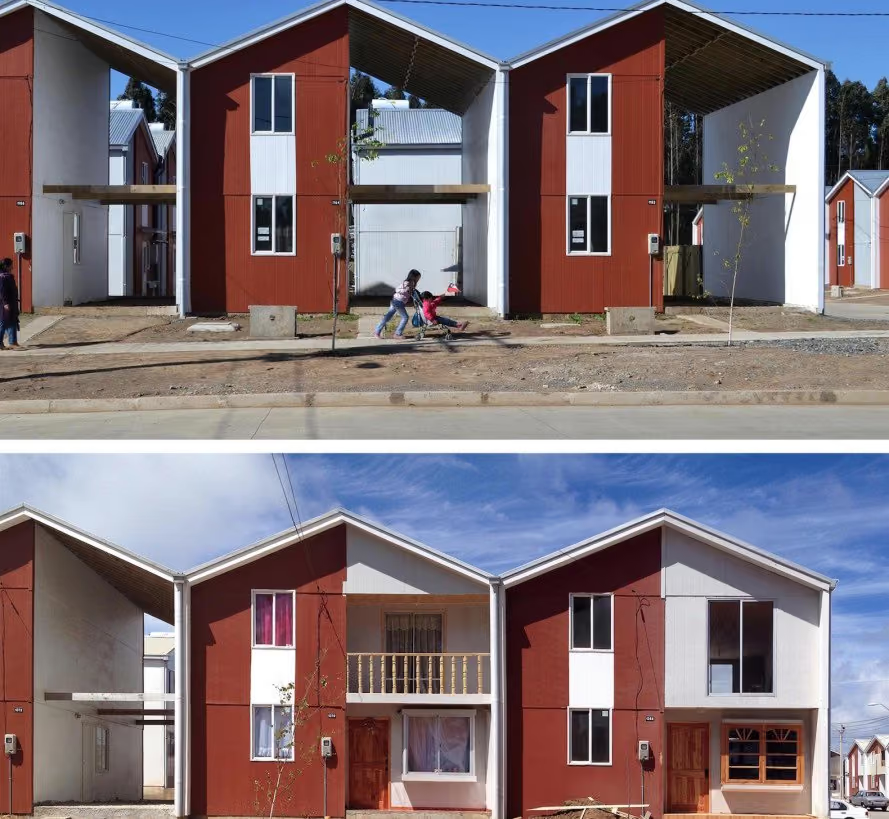
public housing by Alejandro Aravena, above, what was built for residents, below, how they finished the houses
On the Bookshelf: The Omega Seed (1981), by Paolo Soleri

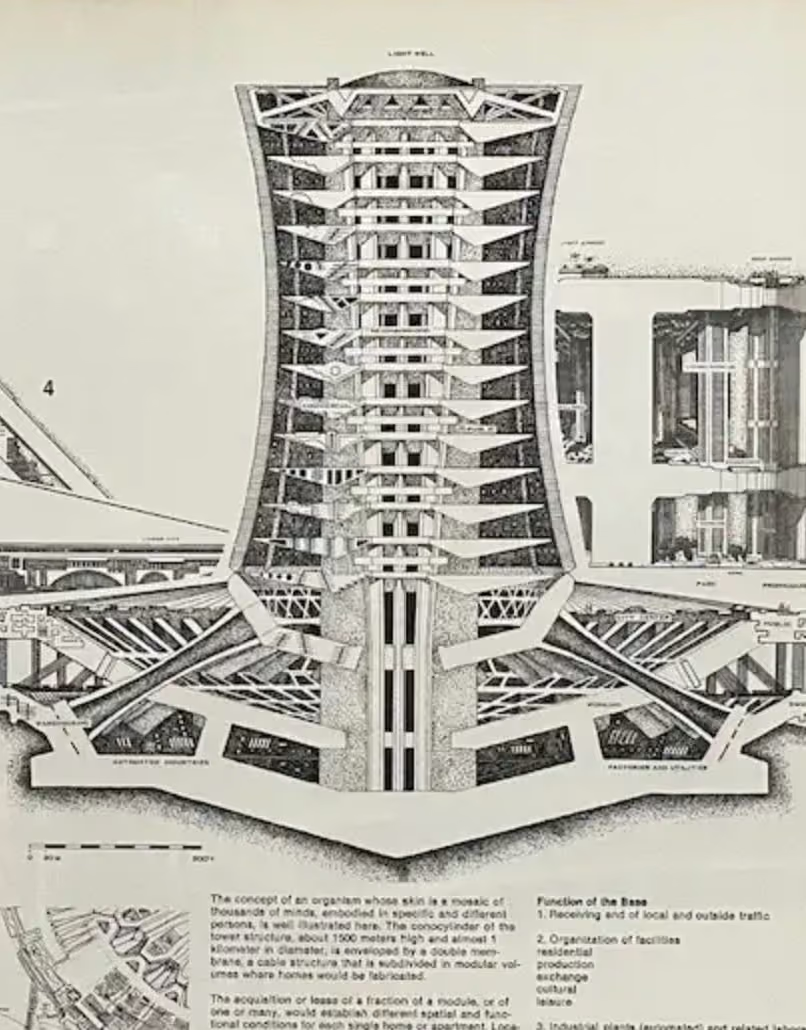
I’m in no way trying to provide a full reading list here for urbanism or architecture, but I think The Omega Seed is worth a look both for the sheer audacity and the practicality of it. Soleri posited a world in which architecture and community design created enlightenment. Yeah. And he built it, or at least the beginning of part of it, at a community called Arcosanti in Arizona.
His ideas were wild, pretty sci-fi and almost fever-dreamy. But thinking about his work compared with the sameness and normalness of our architectural planning and you realize his world might be better. His disruption might be what we need. He wanted to replace American sprawl with long threads of urban density connected by rail. These cities would be designed for enlightened human interaction, and much of the land would be otherwise left alone. He developed the idea of the arcology - the city in a building - and figured it all out in incredible details. Read the book or something else by him. Let the imagination wander, then realize that he started building it. People are building it even today in Arcosanti- you can go spend the night!
The Death and Life of Great American Cities (1961), by Jane Jacobs

New York City was in many ways been the seedbed of American urban planning. Much of our thinking about how cities should be comes from 19th and 20th century struggles here. In the 1960s, New York City was dominated by Robert Moses, who loved to demolish neighborhoods and displaced residents to make room for highways. Jane Jacobs was, in many ways, his nemesis**. She outlined a view of cities as walkable, vibrant, diverse places full of life and complexity. Hers was a humanitarian view of public space. She helped stop Moses from driving a highway through Greenwich Village, and has influenced urban planning ever since.
Notes
*Laozi. (2025, February 3). Wikiquote. Retrieved 09:23, April 21, 2025 from https://en.wikiquote.org/w/index.php?title=Laozi&oldid=3659361.
**There were plenty of others who felt Moses was their nemesis, but few were able to fight back effectively. Sculptor Isamu Noguchi spent his life dreaming of more imaginative playgrounds and a fantastical “Play Mountain“, but was no match of Moses’s power.
