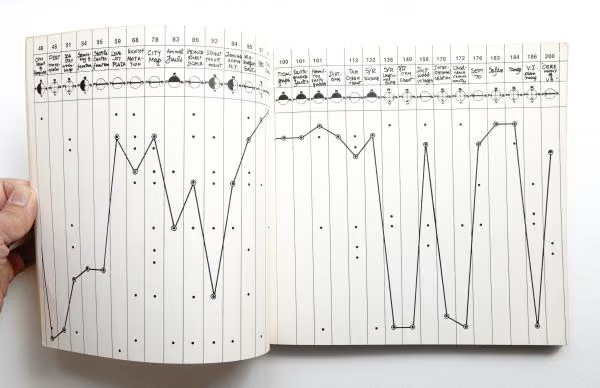
Rethinking the News
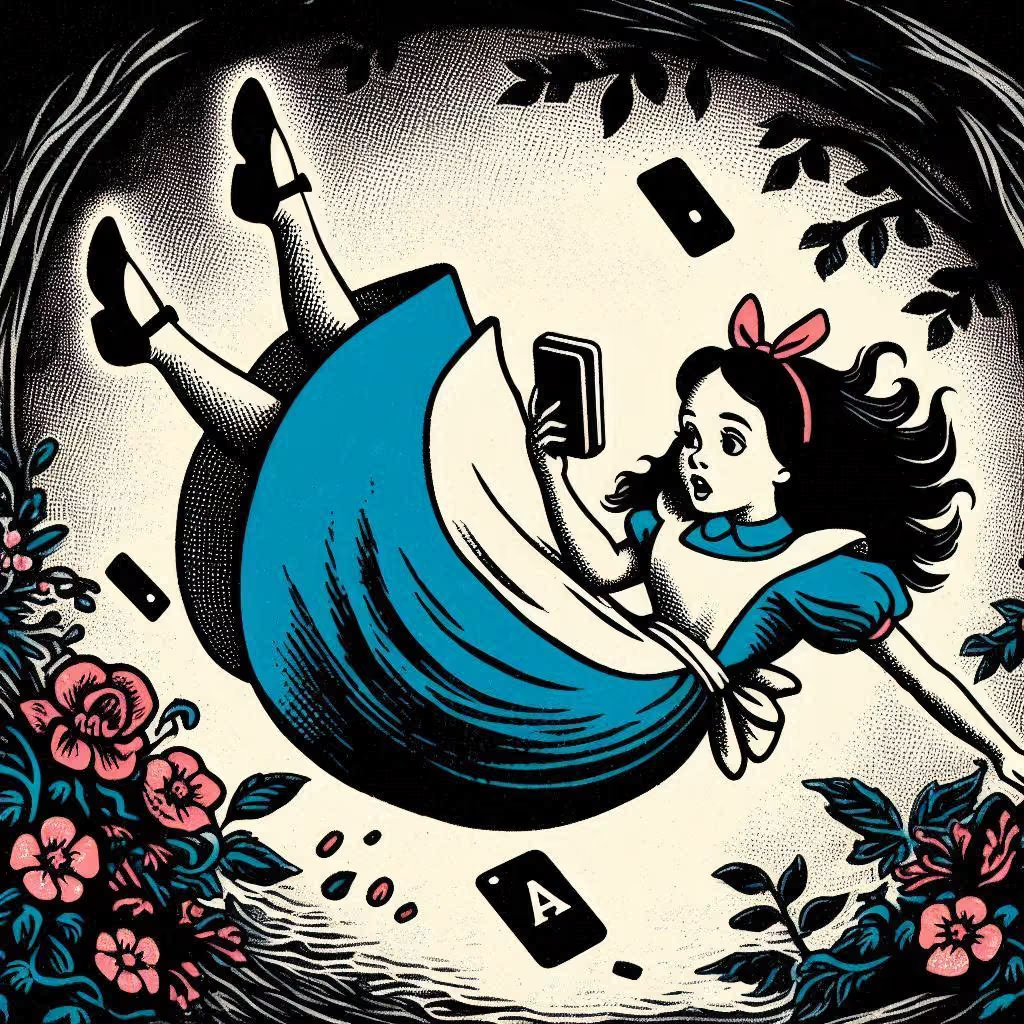
Most mornings I get up early to meditate before making breakfast for the family. I use my phone as a timer – a risky choice for the bleary-eyed and weak-willed. The other morning I opened the phone while making some coffee and fell down a YouTube hole of images of horrible things happening to children in faraway war zones. When I sat down on my bench and closed my eyes, I could feel the cortisol running through my body. I took an hour to quiet my mind before my own children came clomping down the stairs.
I have been struggling with my own relationship to the news for several years now. News stories are called stories for a reason; they are the tales we tell ourselves about the world. A couple of years back I started taking notes on the experience of listening to NPR; four stories out of five seemed designed to produce anxiety or anger and helplessness. CNN, Fox News, and the BBC were worse. After this, our family got a subscription to the Sunday Times and did our best to avoid the news during the week (seems like others are rethinking the news, too.) It helped, but it was not a solution.
It seems strange to think of the news as an experience design. Who designed it? Traditional and small-scale societies do not work with news in this way. Strong communities rely on leaders and community discourse to filter and interpret the news. This is not just a matter of technology but of community values. I experienced this in my twenties, when I lived with and visited with Indigenous and religious communities in South America and the Middle East. At first it seemed a kind of isolationism. After a while, however, I couldn’t ignore the intelligence and community thought process at work.
What would be the right design for our experience of the news? Whose responsibility is it to design it? What is the purpose of knowing what’s happening in the world and how should that information be curated?…
Last year, Ayden and I had a conversation with the director of the Center for Public Integrity, a nonprofit journalism organization. They were producing incredibly well-researched stories about climate and racial justice, but people weren’t reading. They asked if we could have our students take a stab at a different approach. Right now they’re doing just that, experimenting with creating participatory narratives within these stories, creating immersive experiences of the sonic qualities of damaged ecosystems, and inviting you to think like a resident of the Great Pacific Garbage Patch.

Unfortunately, I can’t share these projects with you yet, as they’re still in progress. Next time! Meanwhile, perhaps we can think together. I’ve been interested in recent efforts to rethink the news. David Byrne’s newspaper is trying to get people to see things in a more positive light, and Stefan Sagemeisterargues that we should just slow down, because the more rapid the news cycle the more negative the news. But these arguments seem to do little in the face of screaming headlines.
I’m not trying to argue that negativity is bad and positivity is good, rather that these are choices. What would it be to design an approach to the news that is not random, that considers what is happening from the point of view of a value system? Might that be more respectful? More effective?
The communities I visited in my twenties were tight-knit groups where the news became a dialogue between local values and outside information. What would happen if we scrapped the news altogether and asked how we wanted to take in the story of the world? Who would interpret it (instead of Fox News or the BBC or some other outlet desperate to keep your attention and harvest your clicks)?
I’m interested in your thoughts.I can imagine replacing the isolation of online news with community gatherings where the news is taken in in dialogue. I can imagine news outlets where we cannot get the news without asking a question, and that the news then is algorithmically designed to present a holistic view, looking at current events and historical context (AI perhaps?). I can imagine each of us developing syllabi (with help!) through which we curate our investigation of the story of the world, leaving plenty of room for the unknown and the emergent.
What can you imagine?
On the Bookshelf (out-of-print edition)
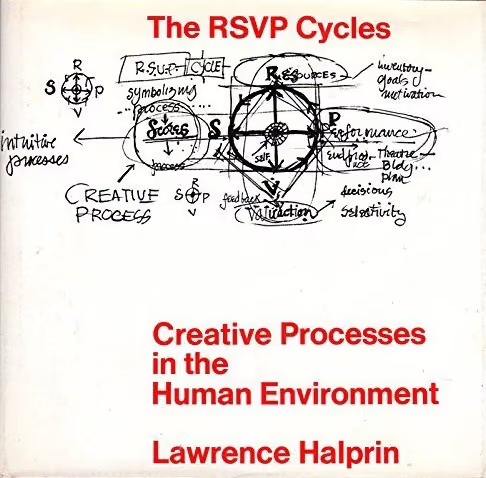
If you’re a designer or dancer in the San Francisco Bay Area for long enough, you’ll inevitably come across Lawrence and Anna Halprin. They were a legendary artistic power couple whose work in the 60s and 70s left a huge impact on the community and the area. She was a dancer and choreographer and he was a landscape architect, but the whole was greater than the sum of the parts. He designed many of the famous public spaces in the Bay Area, and all over the country, including Ghirardelli Square and UN Plaza.
But he’s probably best known for his work on the Sea Ranch Community, which, in Northern California, was a modernist utopian vision, “designed for creative collaboration”. The bigger picture for the Halprins was embodied in the book The RSVP Cycles, an approach to making art and performance based on “scores”, which are kinds of scripts or diagrams. The entire book is hand drawn and full of energy. I love it for its relentless energy and enthusiasm around allowing modes of notation to open new modes of doing. For him, scores were for performances as much as they were for architecture, dance as much as for daily life. I wholeheartedly agree.