Worldbuilding to Change the World
I’m finally coming up for air after releasing my book. I really ought to take a break, but I have two books that I would love to write and I’m not sure which to start on. I figure: you’re my ideal audience, why not ask you?
The point of either book is the same: worldbuilding can…well…change the world. It seems both self-evident and too much to ask; what does Westeros have to do with solving global warming? How can the new Dune movie move the needle on our relationship with the earth?
By themselves, not a lot. But the more we examine the world in which we live the clearer it becomes that our world is no less designed than these fictional worlds. The design is so thorough, so long in the making, that we don’t recognize it as artifice. In my Experience Design book I look at a few people who changed their worlds—Gandhi is the clearest example—but there are many others. Leaders like him make evident the hand of design in so much of life, and how, with some intention, we might redesign life.
Consider our efforts to address climate change. Brilliant minds are hard at work coming up with brilliant solutions. A friend of mine is working at a company close to releasing the world’s first net energy fusion device. In Iceland, folks have built a geothermally-powered carbon-capture plant and others have figured out how to store captured carbon in subterranean rock. There’s a lot of progress; I think the solutions and the technology we need already exist. But such efforts are not aligned with our baseline way of being in the world, as I discovered just a few days ago, on Valentine’s day, when my kid came home with a garbage bag full of plastic junk given to him in a spirit of generosity.
If we want revolutionary green technologies to make a difference, we need to design a world in which the technologies are the point, not the exception. Our world needs to be one in which the longing for a better relationship to the earth is a cultural ethic, not a specialization. Advocacy and protest and posting on social media can help, but what we really need is a different world, offering a different way of being. How, you ask, can this be done?…
If we want to create a different world we need first to see our world as designed. Then we need to explore experiences—real or fictional—of other approaches to designing worlds, then set out intentionally to use the tools of experience design to design our world with a clear aim.
Ok. Help me pick. Here’s two book pitches:
- A memoir of an idea. I spent about a decade trying to get to the bottom of the idea of worldbuilding (though I wouldn’t have called it that at the time). I went and lived in worlds as foreign to my own as I could find, hoping to estrange myself to my own worldview. I lived with the Shuar in the Ecuadorian Amazon, with the Whirling Dervishes, visited with nomads. I also visited communes and intentional communities and started Odyssey Works. The memoir would explore these experiences and think out loud about how worlds are made and how they might be remade.
- A novel about a protagonist who is a devotee of all kinds of games. The protagonist has, like so many gamers, heard the legend of the island where the people live for the collective worldbuilding game, maybe something like The Quiet Year but much more elaborate. Then one day they find a clue; the island is real and the game is real. Of course they head out there and participate. What they find is a community where each day the game is played, and everyone on the island must live by the world the players have devised. It’s an all-in super LARP, or so it seems. Soon the protagonist discovers that it goes much deeper, that the players are not just playing a game but designing and redesigning their own world every day, with occasionally dire consequences.
I had a nice chat with Sam Lubell at Metropolis Magazine, then sent them a bunch of diagrams. Since then I’ve been seeing the form-content-experience diagram popping up all over the place in different applications. Pretty fun.
On the Bookshelf
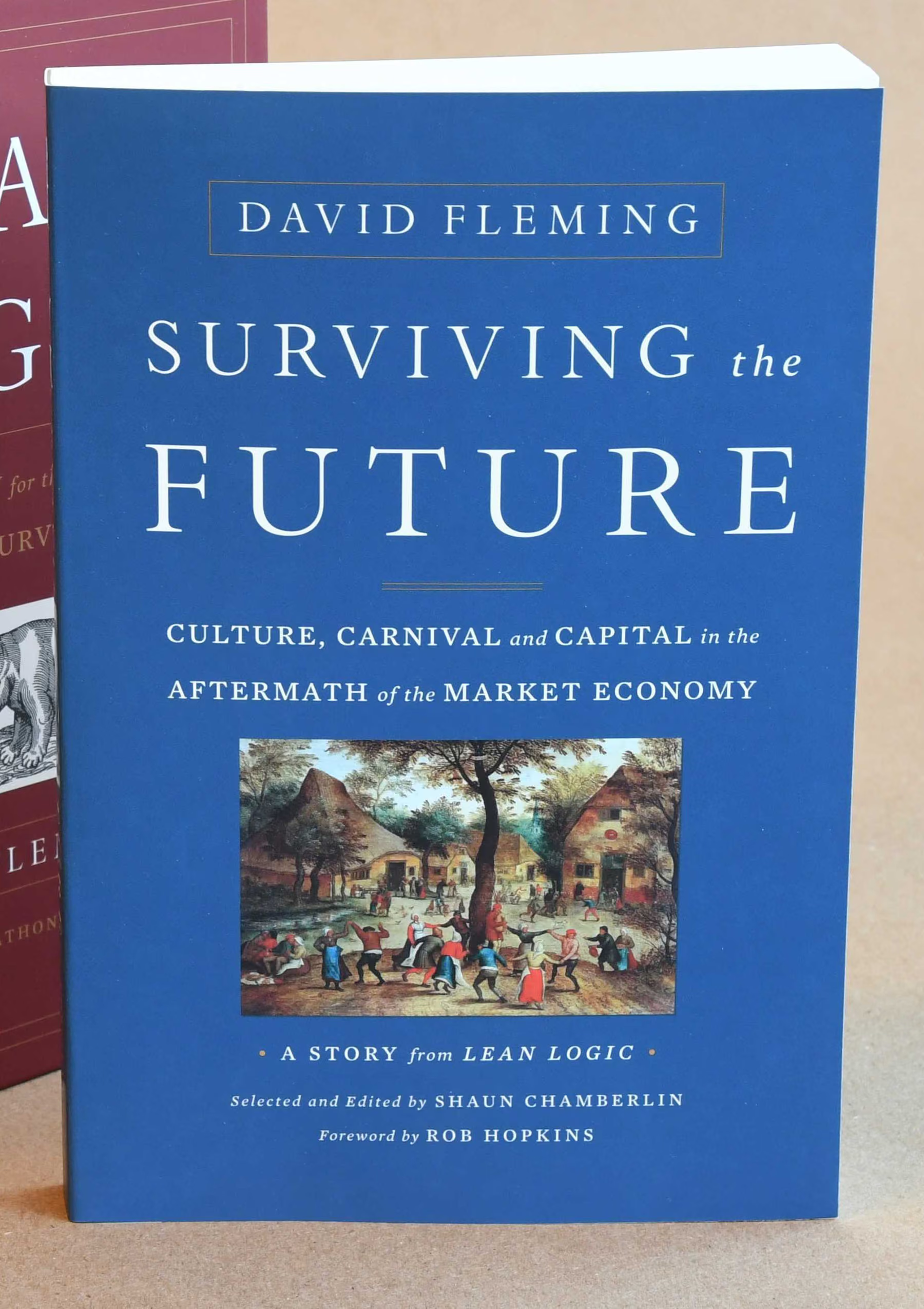
This is not a new book, but Surviving the Future is pretty much blowing my mind. It is a cheery guide to rebuilding society after the environmental collapse. The propositions here, based on David Fleming’s Lean Economics as an entry point to the design of communities, are both radical and, in some ways, weirdly obvious. In sum: small is beautiful, relational is better for humans than institutional, excess production should be used for carnival rather than endless growth. There are so many brilliant moments in the book where I found myself saying: that’s what I’ve been trying to say! One particular moment that made me read the book out loud to my wife was his discussion of education. He advocates a relational, personal mode of education, one that believes in students and finds education at the collision between a teacher’s deepest belief in their material and the student’s deep yearning to learn. Contrary to this would be systemic modes of education (read: most grade-based Western education). Grades and rules and all the small type and declarations of transparency assume the worst of everyone involved and obviate trust. But an education that begins with trust assumes the best of everyone involved and believes in their unique potential. I could go on, but if you’re that interested, read the book.

Stefan Sagemeister came through MICA (where I teach) last week on tour for his new book Now is Better. It is in some ways an art-meets-data-viz counterargument to David Fleming. The thesis is the title; he’s arguing that the data points to now being better than before. He looks at the numbers around women in the workplace, war, disease, infant mortality, etc. His talk was funny and wonderful and, of course, optimistic. he’s no idiot and knows that we have big problems, but feels that the fast-moving news cycle biases more and more toward the negative and longer-term thinking biases toward the positive. It’s a fascinating argument about narrative and the news. And it is, as with all his books, a gorgeous object.
