What Is Odyssey Works For?

It got me reflecting, at the turn of the year: what has Odyssey Works been for?
Several years ago, Ayden and I were asked to help a group at the Austin Presbyterian Theological Seminary rethink Advent. Neither of us are Christians, which may have been our appeal: we could look at the practice with new eyes. What we saw amazed us: a month of inner preparation for change, for revelation. What an experience design! The group was young, liberal, and trying to find a way to authentically match their convictions with their faith. It was a dynamic, emotional, optimistic project. Participants walked away with a new alignment with their religion. We walked away energized: experience design can do amazing things. It can align the forms of our lives with the aims of our lives. It can bring intention back to the way we put things into the world.
This year, we explored what Odyssey Works, and the approach to experience design it represents, could be for. Our Certificate Program students worked with the WWF (the pandas, not the wrestlers) to investigate how experience design could help them with the great challenges they faced. Along with Anne Gottleib and Stefanie Posavec, we wrote and designed Yoshua Bengio’s TEDtalk (1m views already!) about the risks of unregulated AI. We enrolled a cohort of kids into a top-secret multi-year narrative experience meant to offer them a meaningful community and a sense of agency as they become adults. We started an experience-design-for-parenting group. We worked with Alberto Martinez Garaulet to develop a deck of worldbuilding cards. We brought workshops and programs to New York and the UK and Brazil. We launched a working group to work through best experience design practices for climate.
In October, I gave a keynote address at the HUB conference in Montreal that spoke to what experience design could be for. The folks at Hub built a phone booth so that people could call Krishnan Unnikrishnan’s AI and tell it what they were really thinking about the future. With Krishnan’s help, and Anne Gottleib’s guidance, I presented a talk that responded directly to people’s hopes and fears for the future. The response was overwhelming and humbling. This is what experience design should be for, people said.
In our 25th anniversary year, we will make an Odyssey on a Greek Island (you know…like Odysseus…). I’ll deliver more keynote addresses, including at the WXO summit in April. Our Certificate program students will explore even more ways that experience design practices could be applied to big real-world problems. Our consultancy will continue to work on AI safety, on transforming a small town in Ireland utilizing arts grants, and with various arts organizations to explore how what they actually do might better align with what they hope to be for.
Ayden LeRoux’s Final Year
As I write this, Ayden LeRoux is sitting in her artist’s studio in the Cité Internationale des Arts in Paris, just blocks from Notre Dame. I imagine her typing away at her Corona, an unlit cigarette in her mouth, the butt of a baguette on the coffee saucer. I’m tempted to use AI to make that image look real, but I know she wouldn’t approve.
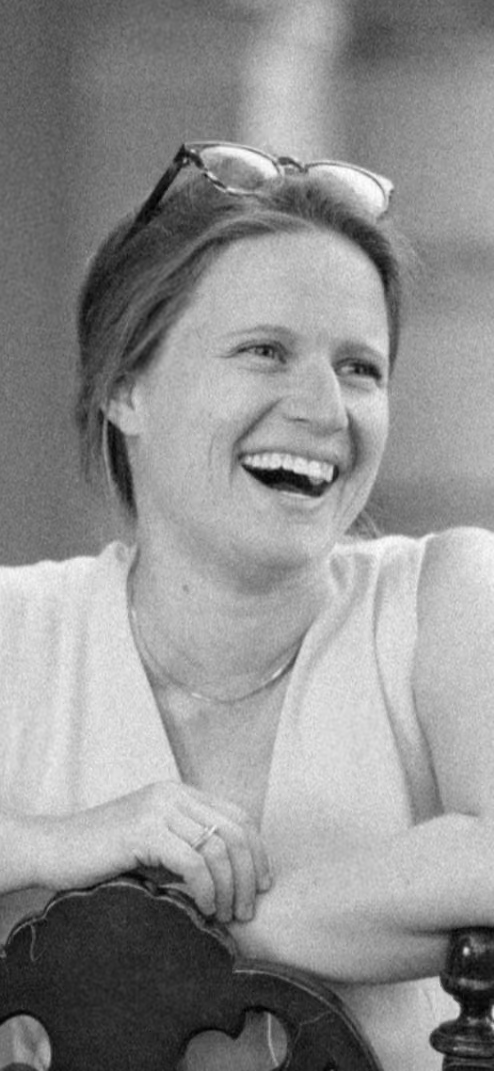
Ayden doesn’t actually smoke, but she will be there for six months, working with her agent to revise her novel. After that, she’ll come back to teach her last semester of the Certificate Program and help with the transition.
I met Ayden in 2011 and started working with her in 2012 on the two Odysseys we did that year. The next year we gave the inaugural lecture at the Adventure Design Group in San Francisco. It was an amazing gathering of experience designers and artists and transgressive placemakers who would later go on to create such things as The Latitude Society, the Headlands Gamble, Disney’s Galactic Starcruiser, and so much more. Suddenly we had a community and a sense of great possibility. These were the golden years of immersive possibility. Sleep No More had recently blown the world away in New York, but in San Francisco we were breaking into disused train stations and military installations. My first date with my wife was late at night in the Conservatory of Flowers. We had broken in with a band and fifty friends. People were skinny dipping in the lily pond. We were accidentally married by a red-headed priest amongst the carnivorous plants. It was an exciting time. Whenever they write the history of immersive this moment deserves its own chapter.
Ayden and I started writing books together at this time, ultimately co-writing Odyssey Works (Princeton Architectural Press, 2016). It was a truly collaborative process; there’s not a line in that book that either of us can claim to have solely written. We started our workshops then, approaching teaching as an experience design as much as we had our Odysseys. Ultimately, after spending a day failing to settle on a cool name, we called our year-long program The Experience Design Certificate Program (got a few million for an endowment? Naming rights are still available!)
Along with Sophie Larsmon, Ayden is running the Master Classthis year in Greece and will keep doing so whenever it is possible for her, but mostly she’ll be on to other and bigger things. You can follow her exploits on her substack, Food Art Sex Books.
On the Bookshelf

Charlie Melcher’s new book, The Future of Storytelling is probably his opus. After creating the Future of Storytelling Summit and podcast, then the Explorer’s Guild, he has come to fully understand the field of immersive and experiential. If anyone can know everyone and everything in this field, it would be him. This book covers so much; mostly in entertainment and marketing. It is a visual feast, with [a dozen] interchangeable covers, rich photos of everything from Sleep No More to Meow Wolf to Odyssey Works. When I saw it I knew I’d never see a more thorough survey of the work out there. So I bought copies for everyone in the Certificate program. You should probably get yours.
Also: no AI was employed in the writing of this text. I did use Nano Banana, as well as Photoshop, to make the illustrations, which are based on the graphic language developed by Erica Holeman for my book.
