Phase Zero · A letter from Odyssey Works
What Can a Body Do?
This question has always sounded a little awkward to my ear, but it’s a powerful inquiry and a critical place to start designing an experience from. It was first posed by Baruch Spinoza, then taken up by Gilles Deleuze, and most recently by disability studies scholar, artist, and designer, Sara Hendren in her book of the same title. If you don’t know her work yet, can I recommend you stop everything you’re doing (once you finish this, of course) and listen to this episode of On Being with her. She has an unparalleled warmth and What Can a Body Do? is one of the most approachable yet precise books about experience design (without necessarily using the terminology of such) and (dis)ability I’ve ever encountered.
Sara Hendren’s book is all about rethinking some of our most fundamental design choices to think more deeply about bodily capacity and support. She uses deft shifts in scale between each chapter, moving the scope of her perspective wider and wider to examine the design of our world; she begins with the body in LIMB, moves next to furniture with CHAIR, then to buildings ROOM, public space with STREET, and, finally, to CLOCK.
It reminds me quite a bit of my favorite assignment we give in the Experience Design Certificate Program: the Medical World Hack. We ask students to think about one element of the medical industrial complex and redesign it. We’ve all had horrible experiences somewhere along the line, whether it was a three hour wait, the droning sounds of an MRI machine, or a physician who dismissed your pain or ignored your symptoms. There’s something about how relatable this question is for all of us and how it asks our students to call upon the personal to make a real-world application of the theories we teach them about world building that is nothing short of extraordinary in the results.
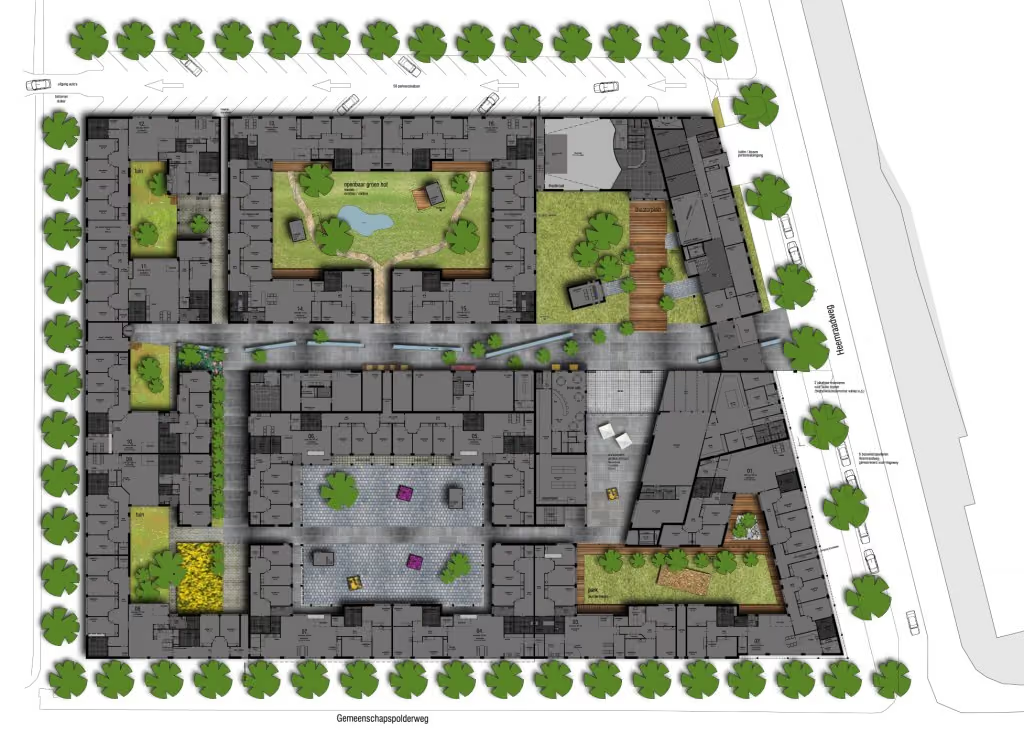
One of the most compelling case studies Sara Hendren offers is in the chapter called STREET illuminates so much about world building. She visits De Hogeweyk, a Dutch memory care facility that was re-imagined in 2009 by an architecture firm to better embody the principles of care they wished for residents with dementia. I first learned of De Hogeweyk in the New Yorker when my grandparents had a long, slow decline with dementia themselves and was fascinated by the way it treated healthcare as a sort of immersive theater. What is most notable about this memory care facility is the way it was created as a small village for its residents, a set they live in complete with a grocery store, hair salon, town square, a bar that has put all the medical apparatuses, nursing equipment, and administration “back stage.” By using the setting of the town, they help to create a sense of home and community for the residents rather than foreground that it is a medical facility.

De Hogeweyk wasn’t always this way–it used to be a much more conventional type of nursing home, but the board conducted what we would call a Phase Zero and decided they needed to better enact commitment to their values: residents should enjoy life’s pleasures, have agency where possible rather than be imprisoned, and the space should be more pleasing than the standard long hallways with the drab nursing home color palette. Now the living spaces are curated to resemble certain tastes and ways of life residents might have had prior to arriving at De Hogeweyk, to give the flavor of familiarity. Residents cook meals in those living spaces with the help of the staff rather than being fed bland meals. The techniques of immersive theater are used even further by caregivers who are encouraged to meet the residents in conversation in whatever place in time they are rather than try to “bring them back to reality”. It’s a visionary and transformative approach to worldbuilding that extends beyond physical space into etiquette around behavior.
I wonder, if you were given the chance to redesign the way you encounter some part of the healthcare system, how would you re-imagine it and make it better?
