Is It Time to Consider Joining a Cult?
Ok, so, if you read about the recent discovery of a death cult in Kenya you were probably pretty horrified. I was too. The thought of falling under the sway of a psychotic ideology and willingly joining in a mass suicide, or finding a loved one who has done so, is not only frightening, but fundamentally challenging to our sense of self.

A few years ago saw the peak of documentaries and books about the dangers of cults. Perhaps you watched Wild Wild Country on Netflix or Heaven’s Gate or The Source Family or The Vow. The script is pretty much the same for all of them – regular-seeming (if gullible) people join the cult and find community, a kind of enlightened attitude, and a loving leader. Slowly but surely, things go awry; one group starts meditating with guns in their laps, others poison the salad bar, and finally a whole bunch of people drink the Kool-Aid.
Of course I’m not suggesting you should go out and do any of these bad things, but maybe we can take a step back for just a moment. Why are we telling ourselves this story? Could this ongoing narrative serve a much broader function than to keep you from giving all your money away to a bearded savior in a robe (and was that actually even an option for you?). There’s a strong whiff of fear of the other in it. These narratives are cautionary tales, there to warn us about divergent worldbuilding. They say that if you try another way of living, or another economic, social, political, spiritual approach you’ll die, or you’ll go crazy. Stay, and don’t try to change things.
Worldbuilding is our great, collaborative experience design project. The things we make, the language we use, the social systems we create, the stories we tell, are all worldbuilding activities. Robust worlds teach us how to be and what to think. There are small worlds, like a home or a workplace, and larger ones like New York or Facebook. Fictional worlds like Oz or Tatooine are no less designed than the “real” world, though perhaps they are more self-aware as designs, and are designed by fewer people. It is extremely difficult to be a part of a world if you don’t conform, in act and belief, to what it allows for.
I have known “normal” people who had spent time in cults. A friend was part of the Rajneesh community featured in Wild Wild Country and said that it was a really valuable learning experience for her. Another friend spent ten years wandering the US under an assumed name in a Christian cult with no possessions other than a bible and a sleeping mat. He’s happily married now with a kid in Brooklyn. The Whirling Dervishes, with whom I spent some time, bear many cult-like qualities. Sure, abuse can happen in these contexts. But, plenty of abuse happens in normative society; harmful belief systems and practices abound in families, in religious organizations, in workplaces, in political movements.
Of course, I was being provocative when I said you should join a cult. But most people in cults don’t call them cults. Most people have found another mode of being in the world that they feel is better than the one they left. It’s this that is essential. How can you expect to change your world if you’ve never experienced anything different? You don’t necessarily have to join a cult; you could go to college, live for an extended period of time in a very different country, go all in on participating in a community with a distinct value system. What matters is that you allow yourself to become a part of that world, because to really experience a different worldview you cannot just be a tourist.
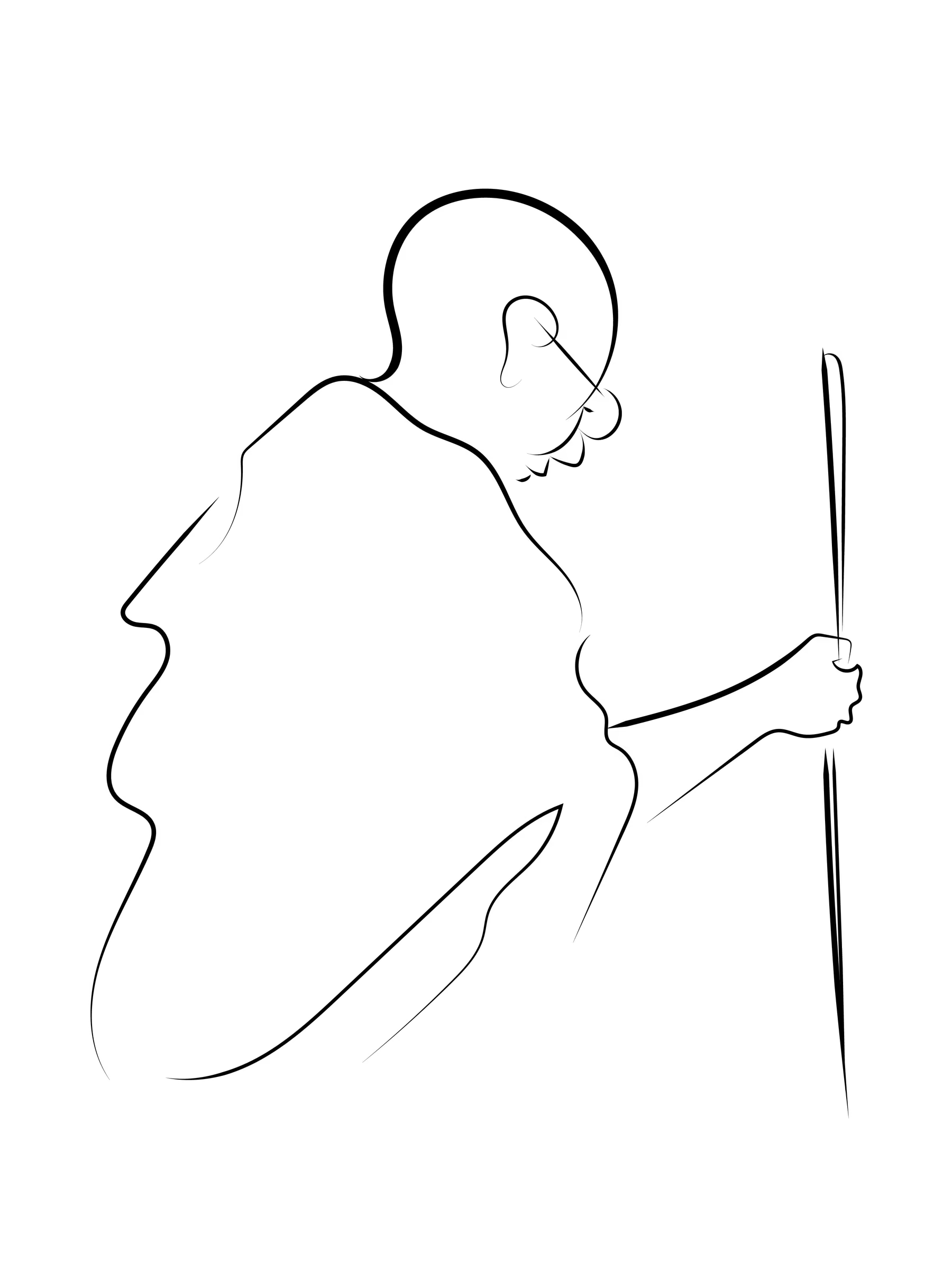
In my book I write about how revolutionary leaders like Gandhi and Che Guevara had experienced different ways of being before setting out to change the world. They traveled widely and saw different ways of being. Their experiences brought them a perspective they couldn’t get, say, from just reading books. The same may be true of walking the Camino, serving in the military, or going to Burning Man. People become parts of these worlds and then return home with a new understanding, and possibly a desire to create change.
So, actually, I do mean it. Go join a cult. Or start one. But keep your wits about you.
Overheard
“Nothing ever becomes real till it is experienced – even a proverb is no proverb till your life has illustrated it” – John Keats
What I’m Listening To
Alex Leff’s new podcast, Human Nature Odyssey, is brilliant and engaging and terrifying. Based around his obsession with the book Ishmael, It’s part storytelling experiment, part book review, part philosophical journey. He’s working with (spoiler alert?) the idea that the problems of the world are not the result of a cabal of nefarious masterminds but of a narrative. It’s an idea fundamental to experience design – we understand our world through stories.
