Experience Design Is Everywhere
For a long time I felt uneasy about the fact that I worked in so many different forms. I designed houses, wrote poetry, made live performance, studied dance. Was I a dilettante? What unified all this was, of course, an interest in how these forms created experience. But it wasn’t until I started writing about it that I realized how long this idea of experience design had been on my mind.
I can trace the interest back to my teenage years. Specifically, to an experience I had with a severe old lady named Peggy. I traveled for two weeks with her and a group of about twenty kids and adults around Mexico. There was no doubt that she was the total authority on our adventure, but she left almost everything up to the teenagers. We were in charge of the maps, of driving (many of us learned to drive a standard on those treacherous roads), of the money, of the food, of everything. The adults were prohibited from interfering, except in the case of real emergencies. It was an emergency when one of the girls dropped the car keys in the alligator pit, but not when the road was washed out at the top of the mountain pass, not when we ran out of food for dinner, not when we were irredeemably lost in the jungle. The journey was ours; it was real and full of consequence, and each place Peggy took us we found ourselves in another world. Some of our destinations were private homes, some were tourist sites; it didn’t matter because Peggy prepared our arrival at these places in such a way that we showed up with a sense of consequence, and a sense of wonder.
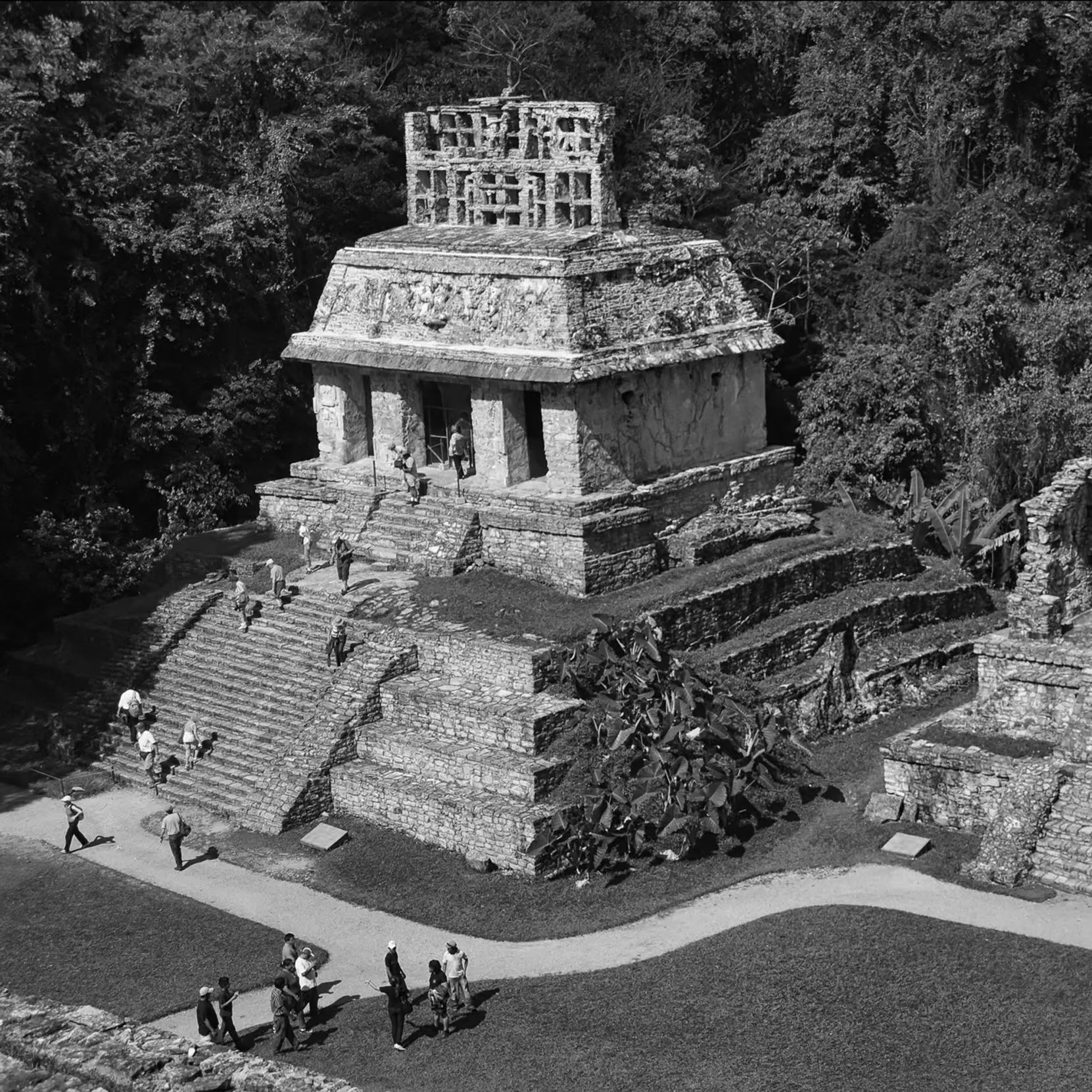
One such place was the Mayan Ruins at Palenque. Here, stone temples rose above the jungle canopy and sprawling plazas suggested a vibrant urban life. After our day of travel, the place was a revelation, not a restored archeological site but a whole other world. Peggy walked us briskly past the maps and educational placards and set us loose with a simple question: what would it have been like to be one of the people who lived here?
Peggy was a brilliant experience designer, though we didn’t have the language for it back then. That always-old lady with the deep-set eyes understood how to cross a threshold into the frame of an experience, how to construct the right narrative, how to play a role.
Walking those ruins was the most wildly immersive experience of my life. What would it have been like to be one of those people? Not a visitor, actually one of those people, worshipping at the temple, sleeping in those stone houses, knowing the jungle so intimately? That time, wandering the grounds and trying to imagine myself as someone else quickly fractured my sense of normal and my conviction that the world I came from made sense. It was an embodied experience, a narrative exploration driven by wonder, a world in which I was question rather than answer.
In the decades that followed, I studied architecture and writing, and traveled widely. I lived in the Amazon Jungle, joined the Whirling Dervishes, co-founded Odyssey Works. The entire time I was searching for an understanding of how different contexts could generate different modes of being, how they might give a visitor, a reader, a resident a different experience of who they were.
I write this as my book about experience design is hurtling through the publishing process. I imagine it is in the queue at a printing house somewhere in Malaysia, just as it is being marked up by a night-owl translator by lamplight somewhere in France. The more I wrote, the clearer it became that I’ve been thinking about experience design my whole life. Because experience design is about the life we can live in the world we build for each other, it touches almost everything. For every case study I mentioned in the book, another got the axe. And for every historical or artistic event I discussed, something in my life said: this too.
This newsletter is meant to speak to the this too. It probably feels a stretch to draw a line connecting immersive theater, war, and the meaning of life to design, but that’s the hope that is driving this newsletter.
Years later I returned to Palenque and I read the pamphlets and the placards, all presenting ancient religions as curiosities, ancient engineering as worthy of celebration in much the same way that we celebrate a child’s first word. History, I discovered later, speaks of the dead with quiet condescension. The experience design of Palenque, the historical site with its guides and tickets and maps, presented the past as context for the more important present. It was certainly not meant to challenge our world, or to destabilize it. It was a past robbed of wonder or transformative potential.
What excites me these days is the recognition that such wonderless packaging of an experience is a choice. We can do things differently. We can walk our audiences briskly past the didactics and ask: what if this were your life?
