How We Fix It #2: Climate

Excerpt from The Heart of The Carpathians, by Brynn Caputo and Cazimi Houdini. Created for the WWF project Forests Forward, during the Experience Design Certificate Program
Odyssey Works just wrapped up a collaboration with the WWF (Wildlife Fund, not Wrestling Federation*). Four WWF groups brought their projects to our Certificate Program students to experiment with. They left us dossiers filled with detailed reports on their struggles to help tigers in Bhutan, to fight European deregulation, to save the natural world piece by piece. As you might guess, It’s not an especially optimistic time for activists; the worldwide rightward political trend has made an enemy of science, of environmental regulations, of experts-telling-us-what-to-do.
From a worldbuilding point of view, it’s fascinating (if horrifying) to watch. Some of the same people who were environmentalists just a few years ago now dispute the science, cheer on deregulation, align themselves with a totally different narrative. The world has changed, and what is socially acceptable has changed as well.
I’d like to suggest that our current approaches are not working. Or have worked as well as possible. Activists have done a lot of great work. The technologies we need to stop climate change are already developed**. The problem might not be just about awareness, but about who we understand ourselves to be in the world. This is a worldbuilding problem, as every world, from a college campus to a workplace to a municipality, provides for us a contextual understanding of who we are and how we relate to others (including non-human others).

Image from the Living With Tigers exhibition proposal by Sarah Jutras, Melissa Carine, and Valerie Caruolo. Read more here.
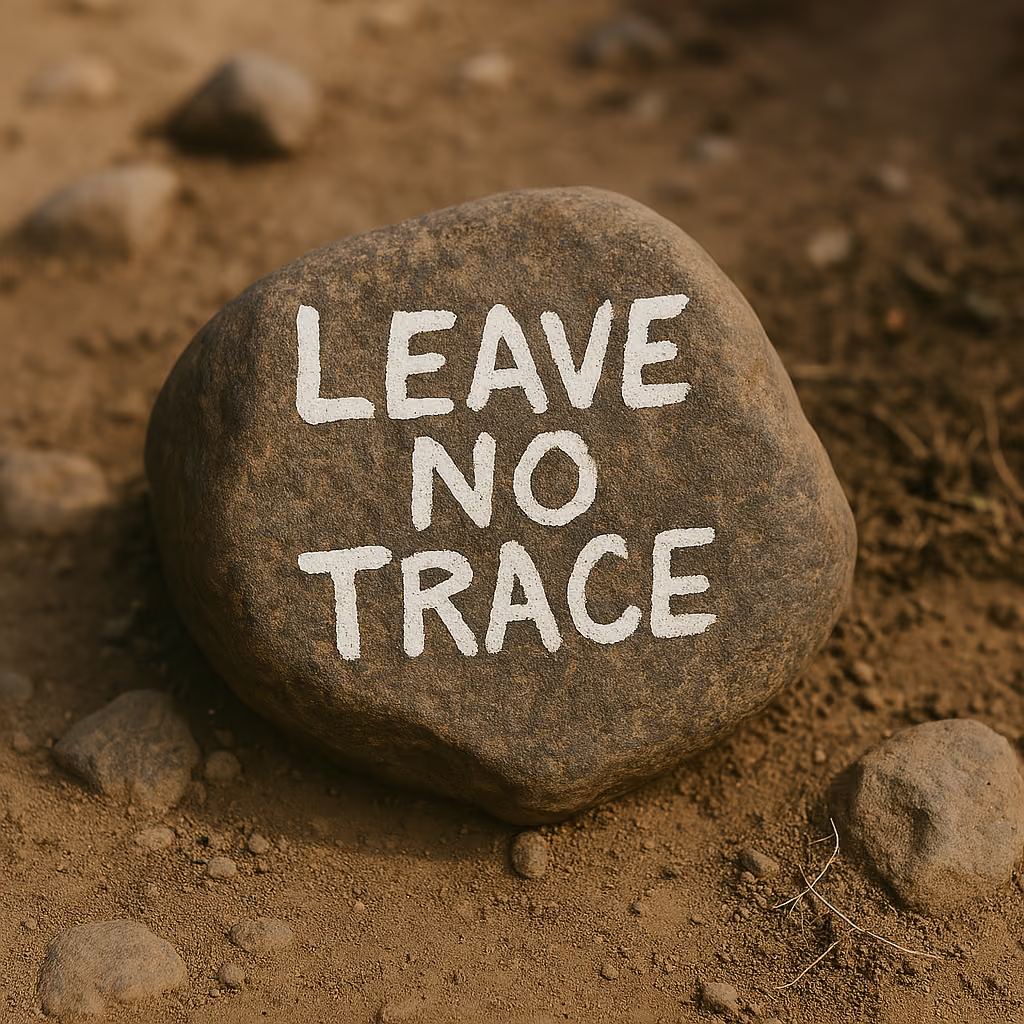
Consider the Leave-No-Trace ethos amongst backcountry hikers. It is central to the identity of a hiker, and central to the structure of the world of backcountry hiking. If you don’t adhere to that ethos you are not fully inhabiting the role of the hiker. A hiker leaves no trace not so much out of guilt, fear, etc., but out of aspiration: this is how to be a hiker, and how to have the best experience of being a hiker. It is not so much what the hiker is doing as who they are in that world.
This is the core proposition: we need to redesign our sense of self in the world, and that sense of self must be one with a different relationship to nature.
In his podcast, Human Nature Odyssey, Alex Leff lays out the narratives embedded in our world that determine that relationship. These are heroic and extractive narratives. What he calls “taker mythology”***. Many Indigenous cultures had entirely different “leaver mythologies”. As you might imagine, leavers try to leave nature better than they found it. They are in a dynamic relationship with nature.
What if we were to change our narratives of the world, and to build identities within the world that allowed us to be different? What if we saw being good to nature as part of who we are, not who we wish to be? Following Leff’s analysis, we are in a narrative of extraction from nature. This means that the roles laid out for us in this world are for individuals who extract from nature. Acting differently is, therefore, an aberration, perhaps a protest. What we really need is to change our world such that having a circular relationship with nature is just part of who we are.
We have a bad habit of thinking ourselves morally superior to our ancestors, but I believe that if we were in their worlds, we might be no better. Horrible things have been embedded in worlds, and worlds have changed. I think of South African apartheid, or Haitian slavery. Those worlds were full of injustice but seemed normal for those in them. Ultimately they changed, and what seemed normal then seems abhorrent now. Gandhi changed the world of India in a few years using the tools of experience design and working with community. In just a few months, Elon Musk has not only devastated the US Government, but changed how corporate leaders understand their roles and responsibilities toward their employees.
We can change a world. but how…?

To Change the World

I believe we need to start with basic narratives, and we need to experience living in relation to those narratives. All origin stories are interpretations of what actually happened. They are stories. They are constantly being revised.
Could we rewrite these to understand our religions as stories of environmental stewardship? There’s plenty of material to work with in the Judeo-Christian texts****. Or your nation? Could we rewrite the US origin story to begin with Native narratives about land and to celebrate those as what it means to be an American? Could we retell the stories of our small communities in this light?
What if we did a top-to-bottom analysis of all the experience design moments that communicate our relationship with the natural world? We could start with our origin stories and then consider all the moments when we encounter them. Pledge of Allegiance? History classes? We could then move on to the built environment. How might our buildings not only communicate but actually necessitate a collaborative relationship with nature? Buildings are generally there to protect us from the elements. What if they were there to connect us to those elements? Our rituals of transition—coming of age, marriage, graduation—always talk about our new role in society; what if they were revised to include nature? Nearly all of the material culture around us—our clothes, our electronics, our vehicles—communicates a total separation from nature. What if it each object spoke of its origins and futures. What if biomimicry were the rule rather than an interesting concept. Above all, what if our redesign of our relationship to nature were not a political declaration, not even something we notice on the day to day and therefore not something we choose to be for or against. Worlds are most stable when they are taken for granted.
We are constantly building and rebuilding our world. The problem of our abuse of the environment is, of course, a worldbuilding problem. Every moment of design, from the design of a birthday party to the design of a car, is a moment to maintain the world-as-it-is or to transform it.Imagine what would happen if we were to understand everything we make in this light.
Are you trying to change the world, even in a tiny way? Please share!
On the Bookshelf: Immemorial (2025), by Lauren Markham
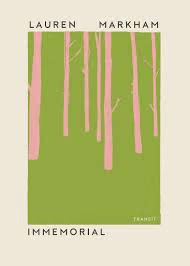
This short book on memorial, monument, climate grief and language is a lovely elegant read. It is a thought process we get to join and then enter into conversation with. Markham explores what it is to create things to remember things by, and how strange it is to proactively memorialize the climate catastrophes to come.
There is a worldbuilding to memorials and monuments. In reading this I found that the poor monument didn’t end up the winner in the exploration of memorialization. Fixed, taken for granted, only occasionally inventive, the monument seems less exciting than a memorial consisting of horsemen riding for 325 miles through the snow to memorialize the hanging of the Dakoa 38 - Native Americans hung on December 26, 1862. A fascinating action that calls attention. But maybe the monuments that fade into the background, into being just a part of the world, are the more effective at worldbuilding for the very reason that we don’t actively examine and critique them.
Thanks for the rec, as always, to Ayden LeRoux, the better reader.
Notes
*We’d be happy to work with World Wrestling Entertainment if they’re on this list. Great experience designers there!
**though more are on the way. Commonwealth energy, for example, has just announced plans for a fusion power plant => ) to be built in the next ten years in Boston
*** A worldview he very transparently credits to the book Ishmael, by Daniel Quinn
****Here’s some Jewish ideas on biblical environmentalism, and some Christian ideas. In writing this newsletter I discovered that Seyyed Hussein Nasr, with whom I studied briefly in college, is considered the father of Islamic environmentalism. I had no idea. Sometimes I’m a bit embarrassed about not having fully appreciated the brilliance of the people I’ve had the chance to meet and learn from. Here’s an article about Islamic environmentalism.
