Architecture as Experience (and a Book Cover Reveal)
The book cover design we actually went with:
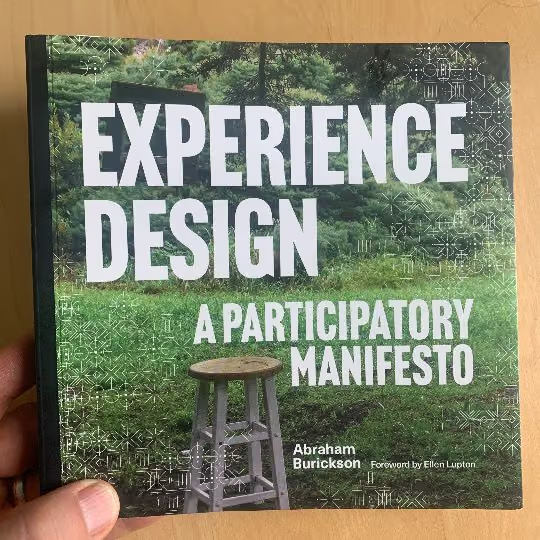
This was, in many ways, a tamer choice than most of the other book cover options, but we all kept coming back to it, and the more we did the more we loved it. It’s elegant, quiet, and radiant. The image is from an Odyssey I made for my (now) wife. She sat on the stool and looked through frames hanging in the landscape in order to see the world differently. It was a quiet moment, but also what I hoped for for readers of the book.Sit awhile; see the world differently. The patterning is created by combining the symbols Erica created for the four different elements of worldbuilding. We spent a lot of time tweaking the way the pattern worked (and made a few abortive pleas for the publisher to print it in gold foil). Symbolically, it relayed the story of the ideas in the book. Compositionally, it was dynamic but not cluttered.
The book will be released October 24, which also happens to be my son Theodore’s first birthday. Auspicious!
When I first encountered the work of the Chilean architect Alejeandro Aravena it took me a minute to understand even what his architecture was. The spread I recall seeing about his work, featured prominently in an architecture magazine, seemed to show a collection of unfinished buildings. The structures were oddly compelling, but there was nothing sexy about it, no eye candy.
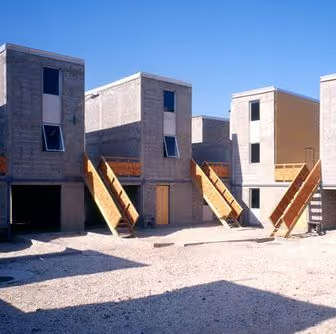
Aravena, who was awarded the prestigious Pritzker Prize in 2016, was making work that challenged the notion of architecture as a discrete practice dedicated to getting buildings built. What, after all, is a piece of architecture? This is one of those questions that can get quickly pedantic or theoretical, but which, in the asking, reveals a ton about the difference between design and experience design. I built the Long Architecture Project around the intention of designing a home rather than just a house. It actually takes a powerful act of imagination to limit any architecture project to the physical structure one is creating. At every step in the process the project bleeds – into environmental impacts, of course, but also into the social structures the building supports or undermines, into the greater experience of the city in which the structure sits, into the sense of self of the people who occupy the building. A building inevitably participates in the activities in which it is implicated. Where, for instance, does the architectural project of a school end and the pedagogical project begin?
Aravena’s half-built houses were public housing projects that provided flexibility and equity to poor people who would otherwise not be able to have either. Aravena built the “hard parts” of the house, and these were sold for almost nothing to the occupants, who then, in the tradition of informal housing across the world, finished it out to fit their needs, building both what they needed to live in and equity in the value of the new structure.
An architect must be trained in how buildings are put together and how plans are drawn, but a description of the architectural project that ends there bureaucratizes any project and dooms it to a thing-based approach to making. In this old mode, an architect like Alejandro Aravena is just not doing his whole job. But Aravena’s genius is to understand his role as a part of a process, an intervention into a dynamic community with its own economics and its own relationship to the making of a home. His skills as a designer of buildings pointed to where and how he could best contribute, but his clarity as an experience designer drove him to limit his work to where it would best serve his experiential goal, his Phase Zero.
I mentioned in my virtual walk that I realized I wanted to be an architect when I was living in Turkey. The Istanbul I knew there among the Dervishes was a world of coal smoke and fantastical legends. Many of the stories I heard were about architecture, one of which spoke of a room in a Bektashi dervish lodge in central Turkey where each person who entered came out in tears.
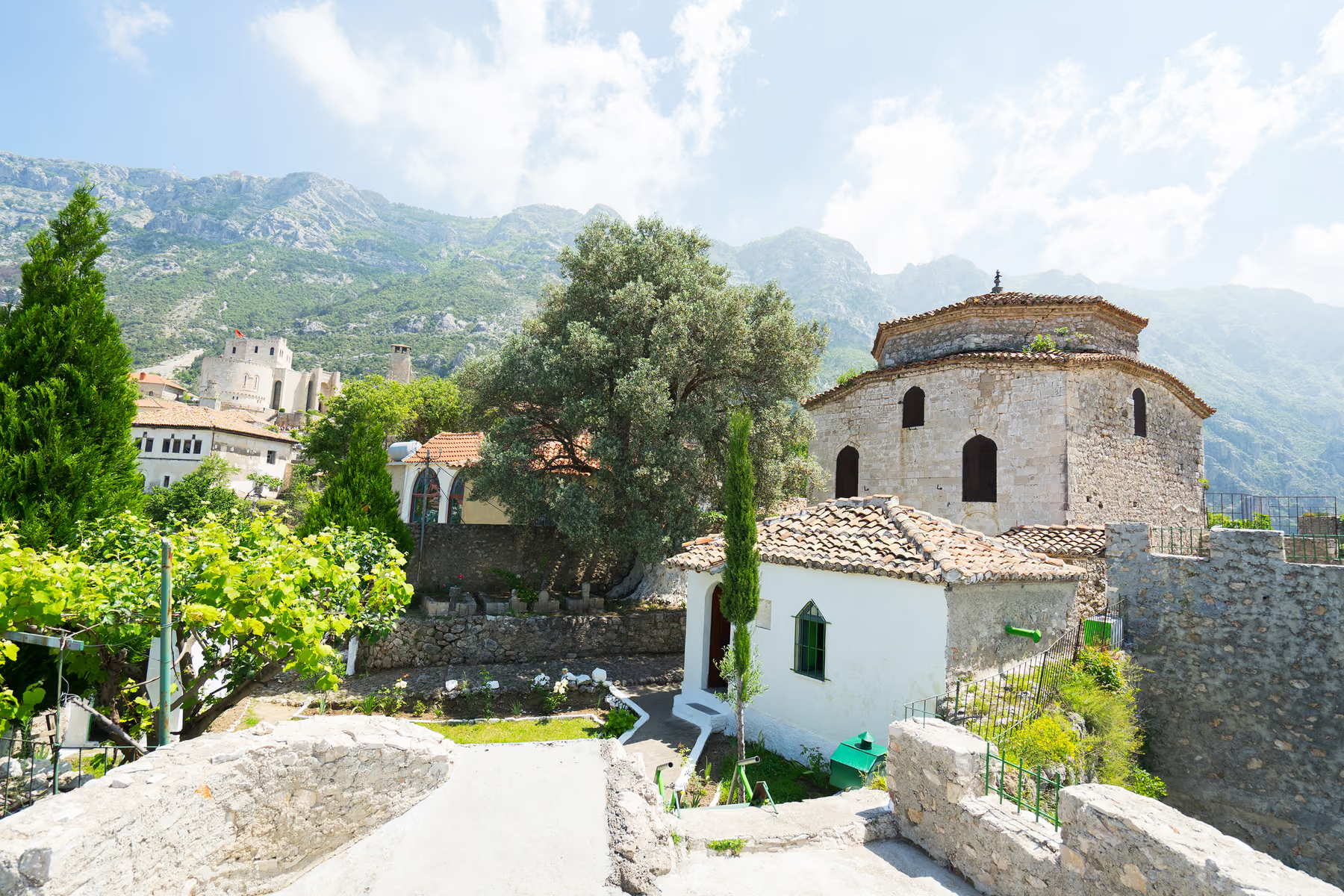
The lodge was located in the middle of nowhere in the hills of central Turkey, but I was able to find it after only a few days. It was beautiful, and clearly a pilgrimage site for dervishes. The room – the shrine at the center of the lodge – would only host a pair of visitors at a time. I had to wait in the antechamber, watching as those who went in spent a few minutes inside and then came out crying. Three different parties did so, and then it was my turn.
I went inside and found the room gorgeous and moving. The shimmering fabrics and the stateliness of the shrines was breathtaking. The dervishes speak of baraka, which is a kind of blessing that emanates from holy things, sticking to you when you are in its atmosphere. I believed I sensed this baraka.
But I was not moved to tears. I left the room with my eyes fixed to my feet, ashamed to be an exception to what seemed the rule. Why? The skeptic in me said those people were crying because they were primed to cry by their superstitions. The self-doubter in me said I simply wasn’t sensitive enough to be affected by the space. Worlds are defined by, among other things, their physics (including metaphysics) and their narratives, and the skeptic and the self-doubter differed on which of these was the cause of the tears. I’ll never know, but what is clear is that I was not fully in that room, not fully immersed in that world. I did not fit within that legend and I doubt my experience would change what people said about the room.
It would not have been possible to design that room within that lodge without the rest of the world that accompanied it. Without the narratives of the dervishes, without the history of the Bektashis, without the idea of baraka, and without the metaphysics of that place. To fully enter that room, I would have had to fully enter all those elements of that world. Though I stood there, moved, impressed by the beauty of it, I was not really in the room, not fully part of that world. If I had been, I’d have been in tears.
