On Narrative
I’m a little embarrassed to admit that I just experienced Meow Wolf for the first time. Based on what I’ve read and the images I’ve seen and the interactions I’ve had with students in our experience design programs, I’ve had a story about Meow Wolf in my head for some time now: it’s a maximalistic creative playspace made by outsider artists who had the chutzpah to break through the art world, it’s a place where new technologies and worldbuilding push the envelope of themed entertainment, it’s a fun house for grownups. I was in town to give a little talk and a diagramming workshop to some of the artists there, so I had to make sure I visited the House of Eternal Return first.
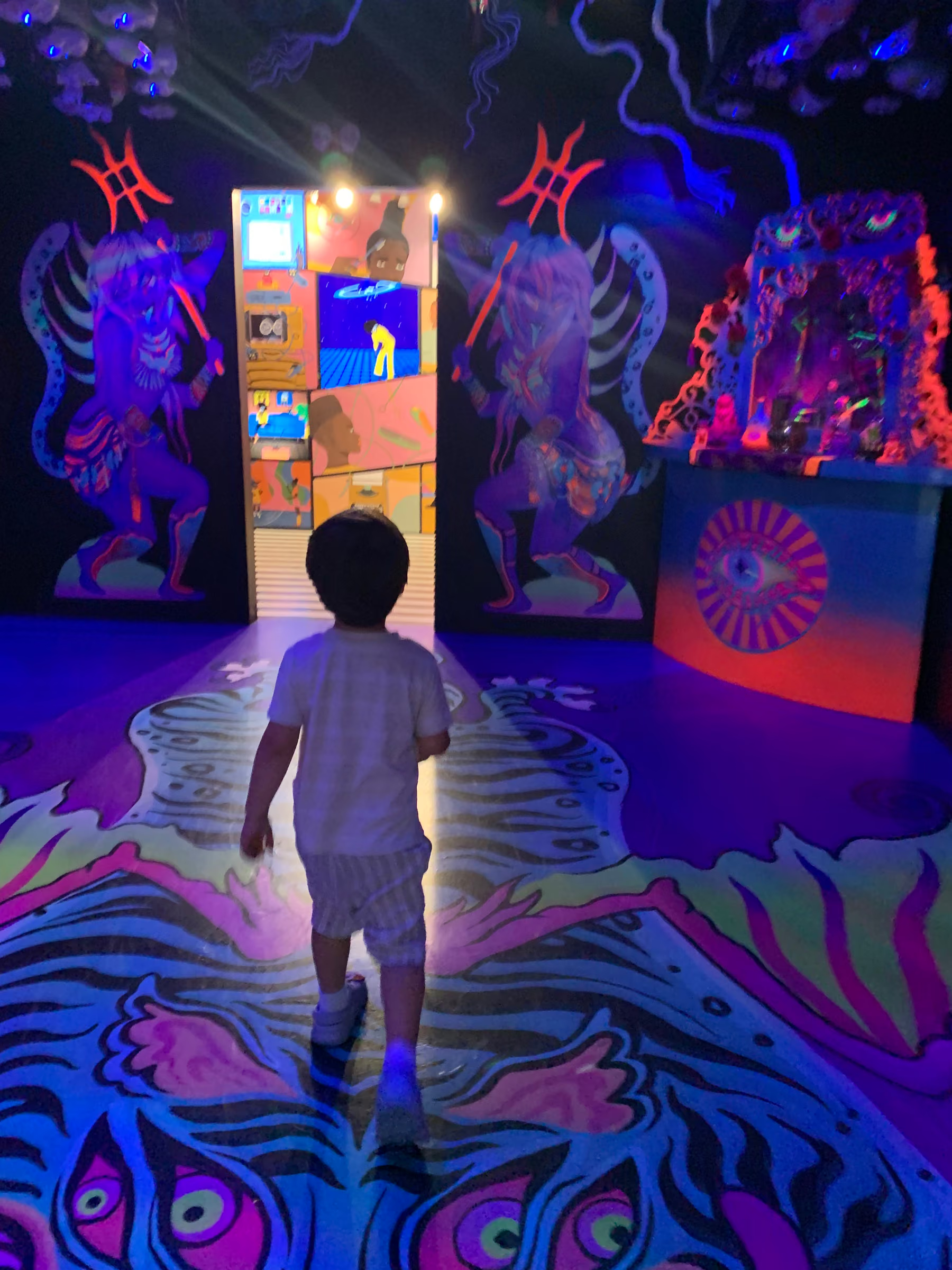
But when I crawled through the fireplace into the dreamspace behind it, none of that was particularly relevant. I had the privilege of visiting with my 4-year old son, who, upon stepping out of the tunnel said, in a long, drawn-out drawl: Whaaaaaaaaat??? It was a precious moment of pure wonder, and it was infectious. It’s not that my previous narratives were wrong, per se, but they prepared me for a different, more analytical sort of experience. That Whaaaaaaaaat??? was a tiny and powerful story. It said: here be wonder.
Stories do this: they prepare us to receive experiences in particular ways. Then the experiences rewrite those stories—a back-and-forth dialogue in which we are constantly engaged. It’s no wonder we feel the urge to talk about our experiences on social media, with friends, in newsletters.
Speaking of stories, did you catch Ayden’s last email about the achievements of our Experience Design Certificate Program grads? I couldn’t help thinking about how the program has been, for many of them, an opportunity to rewrite their own stories. Perhaps that’s what we go to education for: not just to train ourselves on particular skills but to understand ourselves in a new way.
From the moment I arrived in Santa Fe I was struck by the way the city seemed to be continually telling stories about itself. Everywhere we went the story continued: on highway billboards, on restaurant menus, in overheard conversations. Santa Fe was the high-art capital of the southwest, it was an outsider art enclave, it was a sentimental train stop left over from the golden age of rail.
That a tourist town should market itself is not surprising, but what struck me on this visit was the way that so many of the people I encountered participated in this storytelling. It makes sense, to be sure, for gallery owners and restauranteurs to tap into the narrative, but I found that the visitors to the town participated as well, donning panama hats to fit in and sitting around and retelling and reinterpreting the stories to on another. A wonderful collaboration in the group project that is the story of a place.
Like any place, Santa Fe has plenty of different stories that one could tell. It is our job (or our relentless activity) to weave a thread through the narrative elements we encounter to make a story that makes sense, and that justifies our being there. That’s what so much immersive entertainment is about - this worldbuilding via storybuilding. And so much of what our life is about, too.
What I’m Reading
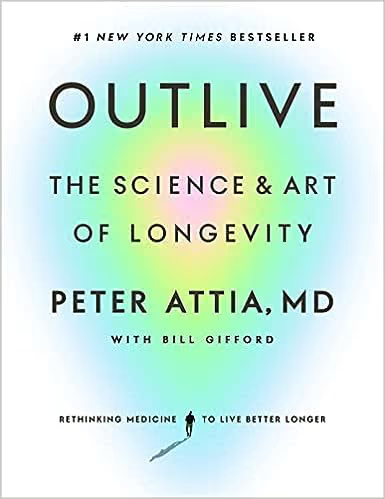
I’ve had Dr. Peter Attia’s book on longevity—Outlive—on my breakfast counter for a good while now. It’s a tome of a memento mori, with page after page of explanations of the various ways in which you’re already on your way to the undiscovered country. Attia’s primary proposition is not so much that we do certain things to live longer, but that we redesign the entire field of medicine. He calls it “medicine 3.0”, which is, to paraphrase wildly, an approach whose focus is not just to treat diseases as they arise (that’s the current system, “medicine 2.0”) but to design a vital life- and health-span for each individual.
More than just shifting to include prevention in the standard medical practice, medicine 3.0 represents a shift in the Phase Zero of a medical practice, an aim not so much to cure disease but to create a better life. It is, by another name, an experience design approach to medicine.
