Anatomy of a TEDtalk
In March of last year, out of the blue, Anne Gottlieb sent me a text: “Would you consider,” she wrote, “working with me to help one of the godfathers of AI create an experience for a TEDtalk audience?…I had sworn off taking on any more clients, but this message is too important and urgent.”
I had met Anne the year before; a theatre maker who had developed an amazing practice in presence and translating how to bring a sense of meaning and depth to the voice for global thinkers, leaders and artists. She had then signed up for the Certificate Program and brought her entire self to the experience. I knew working with her would be intense and wonderful.
What I didn’t know was that within a month we’d have written and directed and served as creative directors for a talkthat would be seen (as of this writing) by over a million people, cited in research, and used as material to confront Sam Altman and Eric Schmidt and other leaders.
But here’s Anne about that beginning:
When Yoshua Bengioand his team reached out to me about this TEDtalk, I was intrigued but confused given my lack of knowledge about AI. My work with leaders, artists, and visionaries has taught me to soften and listen for the essence of what someone must communicate. And this is not always readily apparent to the person themselves. I was struck by the heaviness of what Yoshua was carrying, a man with a genius who had hoped his groundbreaking work with AI could solve our most pressing medical and environmental issues. But what kept him up at night was the speed at which AI was developing. He felt that without guardrails, the technology threatened the existence of humanity; it was too much for one person to carry alone. The reach of the TED mainstage could lead to more consciousness of the problem and action. I reached out to Abe to join me in this endeavor. Though I had only just begun my year in the Certificate Program, I knew this called for Phase Zero thinking as well as great design ideas.”
Anne and I had both given TEDxTalks before: you know… 18 minute lectures with slides. But this was the official TED conference, in Vancouver. Not only the Main Stage but part of the kickoff to the conference, which was to be focused on AI. Chris Anderson, the TED director, had personally asked him to share his message. We had to create an experience that would rise above the noise and hit people in the gut. And we had to turn a revered, but introverted computer scientist—the Turing Award-winning “Godfather of AI”—who was much happier in the lab than on stage, into a call to action. All in less than a month.
“Would you consider,” I asked Yoshua, “pushing this to next year so it wouldn’t be quite so rushed?”
The Road to 1m Views
Here’s Anne:
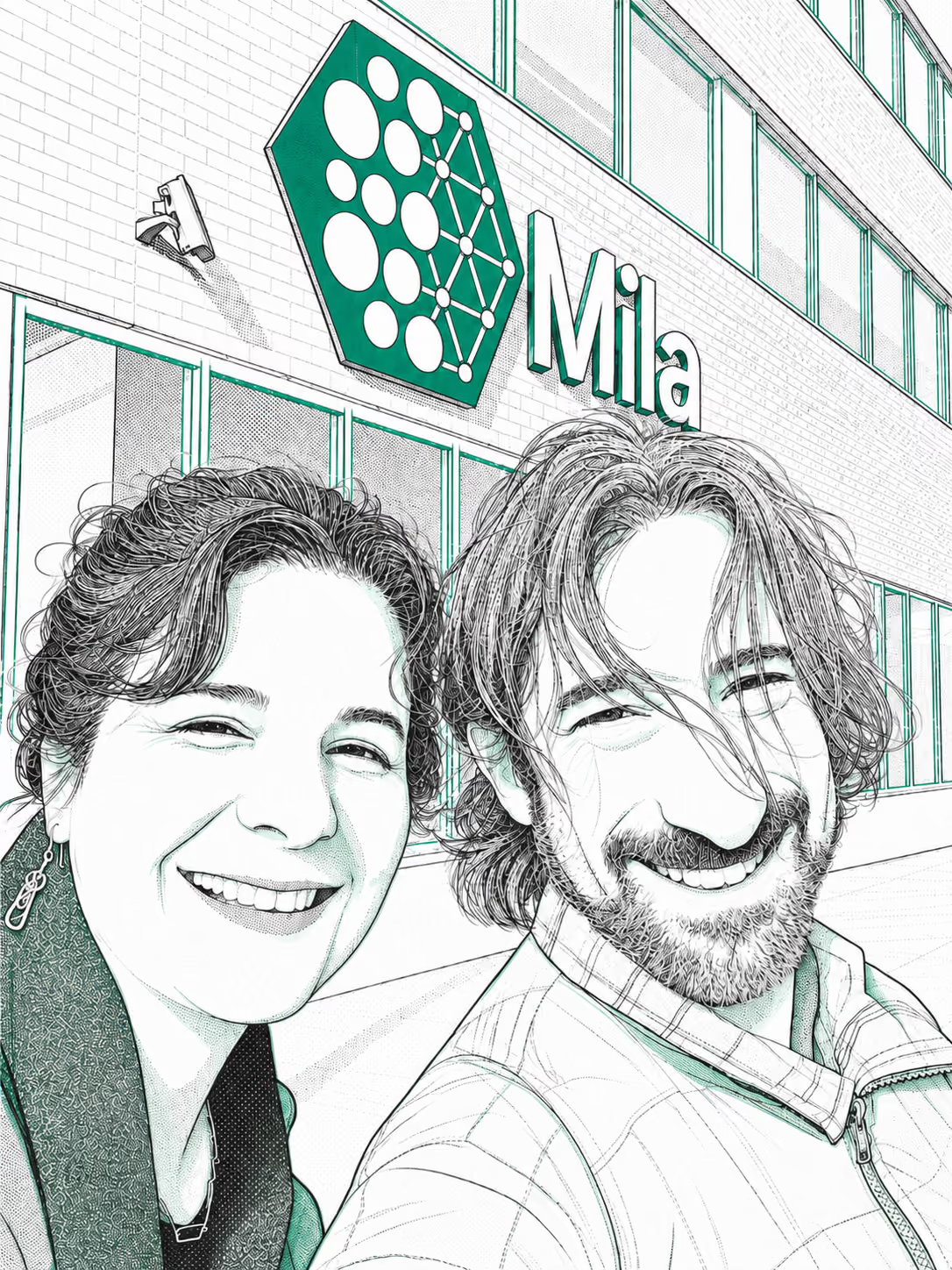
I went to New York to begin work with Abe having spent several hours in conversation with Valerie Pisano, CEO of MILA–the Quebec Artificial Intelligence Institute founded by Yoshua Bengio and Marc-Antoine Guerard, Senior Advisor at Mila and to Yoshua. They would become integral to this process as we flung ourselves headlong and heartlong into the work. We had a week to come up with two proposals that we would present to Yoshua and team. I wrote down the following two images: children and fog. One of Yoshua’s most compelling metaphors was that AI without safety guardrails was tantamount to driving in the fog without knowing if there was a road ahead. His love for his children and their future was undeniable as a motivating force. Abe and I developed these seeds into a structure for what we saw as Yoshua’s primary reason for doing this TEDtalk—preserving and protecting human joy and endeavor.“
We then assembled our team: Taouba Khelifa, our Program Administrator (and Certificate Program Alum), to be our graphic designer, Nehal Modi, my brilliant former student from when I taught at MICA’s Graphic Design MFA, Brooke Viegut for storyboards, me as Creative Director for the visuals, Anne and me as writers, and Anne as the director of the talk itself coaching Yoshua to bring the script to life, rewriting it with him, holding a vision that actually worked on stage and then challenging us to redesign the graphics when the performance needed it.
But we needed one more thing. We needed a data visualizer who could bring the sense of the human to the digital. Someone who could illustrate the situation without dumbing it down. Someone who could humanize the relationship between humanity and AI. We needed my favorite data visualizer: Stefanie Posavec.
The arc of the experience we wanted to create was broken into three unequal parts: The bulk of the talk walked the audience from the optimistic dream of the future which drove Bengio to develop neural networks, to his first encounter with ChatGPT, to the recognition of the great dangers it posed, all the way into the worst nightmare scenarios. The second part zoomed out and took stock of the whole problem, tonally shifting and inviting the audience to reflect. The third part contained the call to action: the solution Bengio was working on – Scientist AI– and hoping to deploy to the world.
We dove in right away; here’s Anne: “Abe and I met for days across a table with tracing paper and Post-Its and markers, toggling between imagining, diagramming and drawing out Yoshua’s journey. Then I flew to Montreal twice to work with him in person, once just the two of us, and once with Abe and the whole team. My first week with Yoshua was about sensing and listening to him. I saw not only his brilliance but his enormous compassion and concern. I didn’t want to exclude any of it. Knowing something about audiences, when a person with this kind of heart who has made this level of contribution speaks sincerely about his worry for the future, it lands.”
On the Bookshelf: The Invention of Nature, by Andrea Wulf
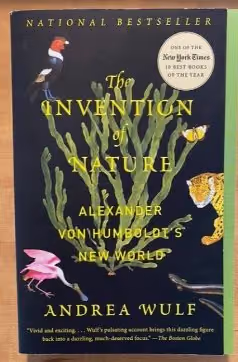
Alexander Von Humboldt is not a household name, but without him there would be no Darwin, no Art Nouveau, possibly no Simón Bolívar. His influence was so vast, his worldview so original, that it’s hard to believe he was the rebel he was: a queer adventurer in 1800, anticolonial and anti-slavery and the visionary who brought the notion of ecology to the world. He believed that all of life was a unity, that humans and animals and the earth were touched by the same interconnected life force, and that science should be free to unearth what the heart fell in love with.
I love this book both for the adventurism and for the window onto a time when the poet and the scientist were not in different departments. Humboldt’s science is a passion for understanding the poetry of the earth, for finding its hidden reasoning, and for connecting a sense of awe to a sense of order.
We don’t know much about Humboldt in the US these days, even though we have universities and counties named after him, because he was German, and in the mid-20th century we purged Germans from our history books. It’s a crime to have done so, but it makes reading this book feel like discovering a hidden world, much in the way Humboldt did.
Generation AI, by Gregory Stock
Though this book is enlightening, I’m not necessarily recommending it. It’s a poorly written and poorly reasoned book, which was a shame because I really liked Stock’s more famous The Book of Questions. This book feels like it was written by AI, which is because it admittedly (partially) was. It’s full of leading “provocative” questions that lead the witness toward AI utopianism (“If your kid could have a friend who was always there for them, always understood them, but was an artificial intelligence, would you want it?” Are you kidding me?) Chat GPT even wrote one of the blurbs
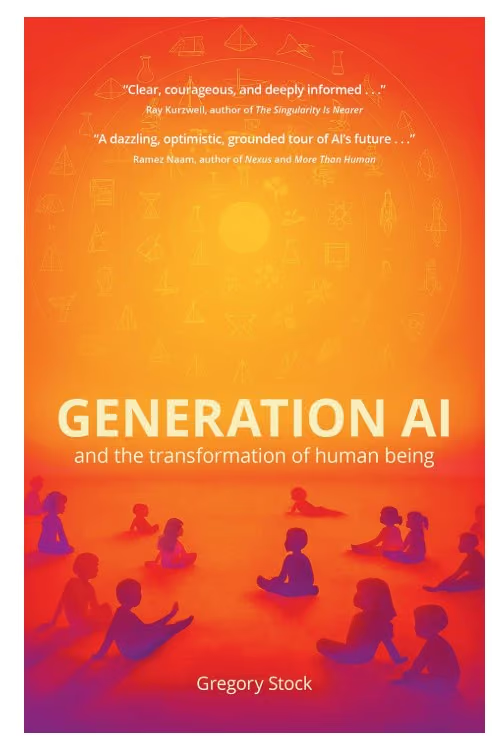
I am sharing it here because it helped me understand the thinking behind the AI utopianists. It lays out a future that seems horrifying to me - humans giving up on other, less agreeable human relationships and replacing them with AI, getting all their personalized education from AI (no teachers), hardly having to work. It dismisses the problematic risks of AI by saying things like: well, if AI wanted to kill us all it could, but why would it when it could just manipulate us into doing its bidding? At one point it cites the Yoshua Bengio TEDtalk that is the subject of this Phase Zero, but the citation gets the year wrong: a hallucination.
The author brags about the speed with which he was able to write and publish the book with AI, though it is twice as long as it needs to be and contains errors. This is the future he looks forward to, when everything is better, when books don’t need editors anymore and the gatekeeping publishing houses are shut down so that the slop can flow freely. If you want to know this point of view well, go ahead and read it.
No AI was employed in the generation of the text. I did use ChatGPT, as well as Photoshop, to make the illustrations, which are based on the graphic language developed by Erica Holeman for my book.
